Thank you to all our visitors for making our run of 6 show-dates thoroughly enjoyable. From all the face-to-face feedback we had at each event it seemed like everyone enjoyed the experience too. If there is something you’d like to share then please email us your thoughts via our contact page.
Here’s to the future! Whether this includes pre-purchase ticketing we’re not sure as we survived this summer season, but we understand that visitors from further afield may not have ventured in our direction because of the uncertainty associated with lack of pre-purchase ticketing. We will look to remedy this situation in the future.
Escape the Earth’s atmosphere and immerse yourself in the cosmos!
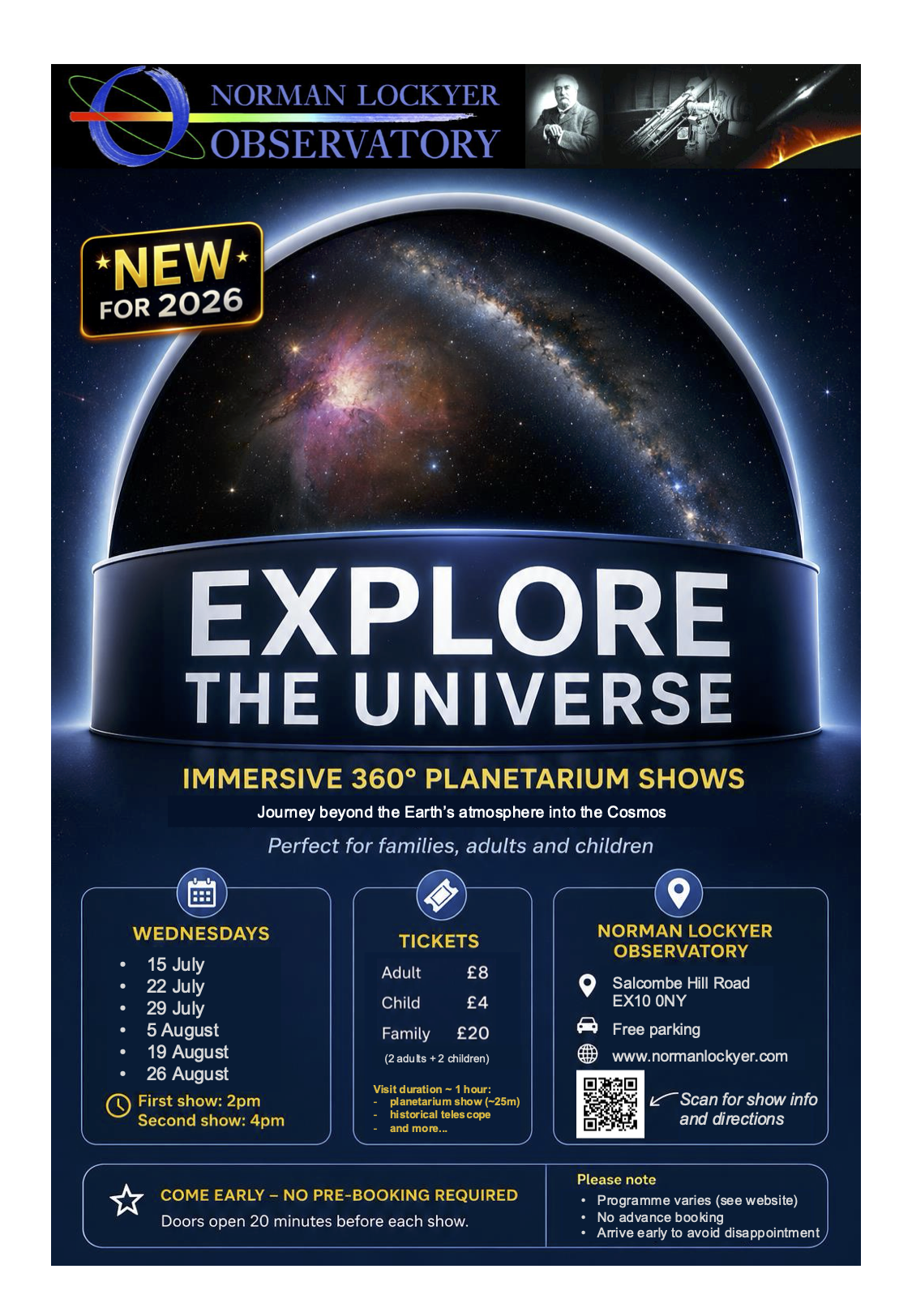
We are hosting Wednesday-afternoon planetarium shows over the school holidays (apart from 12th August when we are hosting a partial solar eclipse and Perseid meteor-shower evening!) with a range of 4k full-dome digital shows from the European Southern Observatory, NoirLab, and others. Please see the table below for a list of the shows together with timings and descriptions.
Important information (updated 2026.08.24, 08:44):
- Main showtimes are 2pm and 4pm. Spaces in each show are limited to 30 people (see ‘How it works‘ below for more details). If the main shows are full when you arrive, we will run an additional show shortly afterwards. No pre-booking currently available.
- The shows are suitable for all the family, ages 8 through to 80 and beyond! Younger children who are well-behaved and can sit quietly for 30 minutes are welcome.
- The car park will be closed and locked at 5:30pm or after the last show if earlier.
- If you have any accessibility/mobility concerns please mention this to our volunteers when you arrive. We are happy to make adjustments where possible. (see ‘Accessibility Statement’ below)
- Please bring your own refreshments. Water available on request.
- We are an organisation run entirely by volunteers (no one is paid) but we passionately believe in sharing the wonders of astronomy and the cosmos with everyone who visits us.
To find us, please click here: https://normanlockyer.com/visitor-information/finding-us/
| Date | Time | Show |
|---|---|---|
| 26th August | 2pm & 4pm | A repeat showing of: The Sun, Our Living Star The Sun has shone on our world for four and a half billion years. The light that warms our skin today has been felt by every person who has ever lived. It is our nearest star and our planet’s powerhouse, the source of the energy that drives our winds, our weather and all life. The passage of the Sun’s fiery disc across the sky — day by day, month by month — was the only way to keep track of time for countless past civilisations. Don’t be fooled by the terminology; although it is a typical dwarf star, the Sun consumes 600 million tons of hydrogen each second and is 500 times as massive as all the planets combined. Discover the secrets of our star in this planetarium show and experience never-before-seen images of the Sun’s violent surface in immersive fulldome format. NLO’s description: This show focuses on the relationship between the Earth and the Sun. It considers the structure of the Sun, its energy source, its turbulent atmosphere, how light from the Sun powers the Earth both in the past and now, and how space weather produces the beautiful aurora. It describes what will happen in the far distant future and how it is destined to make the Earth uninhabitable, or worse! The show is targeted at teenagers/adults. Nevertheless, the visual planetarium experience is suitable for all the family, ages 8 through to 80 and beyond! Narration & soundtrack (synchronised). Contains two short sequences of irregularly flashing lights. Credit: ESO and Theofanis Matsopoulos |
| No more shows | – | The show on 26th August is the final show for the summer. |
How it works: Our planetarium has a capacity of 30 people for full-dome digital shows.
- If up to 30 people arrive the visit will consist of a full-dome digital planetarium show (lasting 25 – 30 minutes) followed by a look at one of our historical telescopes, the Lockyer Telescope. This amazing Victorian telescope was used by Norman Lockyer to discover Helium back in 1868. This living telescope is still used today by visitors to the observatory.
- If between 30 and 60 people arrive they will be split into two groups. Both groups will get to see full-dome digital planetarium show and the historical Lockyer telescope, but not at the same time.
- If more than 60 arrive we kindly ask for your understanding that we have limited capacity. We will endeavour to run extra shows so that no-one misses out, but realistically we may ask you to come back another time, either the same day 4pm if you arrived at 2pm, or the following week (last shows are on 26th August).
Accessibility Statement: Planetarium shows include immersive moving projections, darkness, and occasionally loud sound effects. If you have concerns, please speak to one of our volunteers before the show. If you have limited mobility and would like assistance, please speak to one of our volunteers on arrival. We are happy to make adjustments where possible.
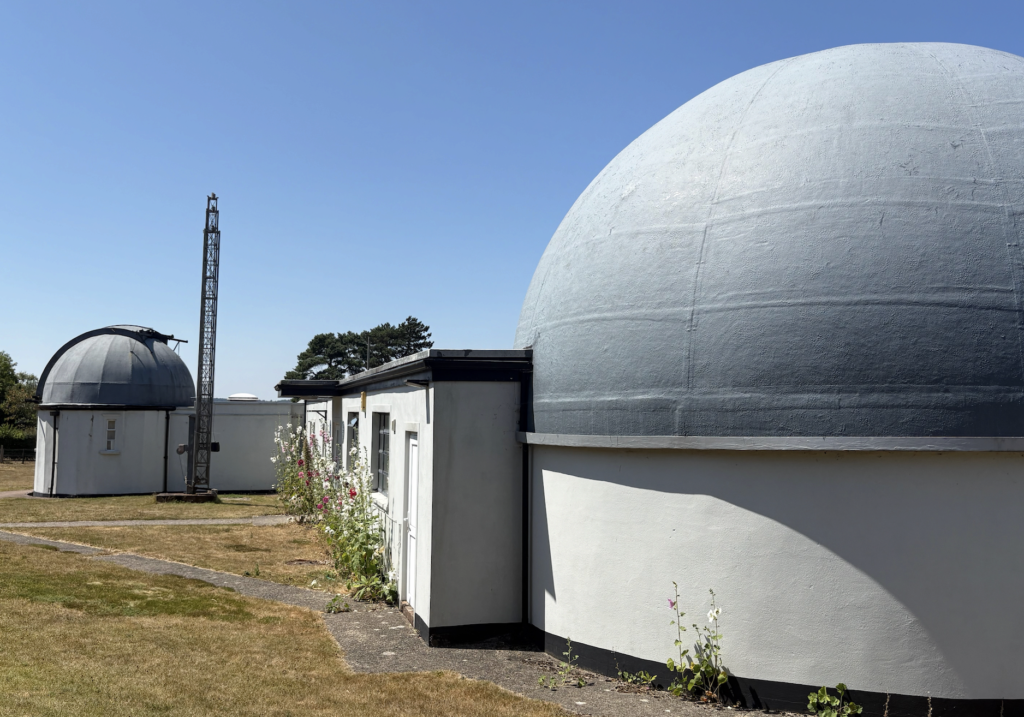
Background: This year (2026) we are delighted to see the emergence of a new digital projection system at the James Lockyer Planetarium, part of the Norman Lockyer Observatory. It offers 360 degree digital video projection, 4k resolution, in a 7 metre diameter dome. We were impressed (which isn’t easy) so we hope you will be too!
| Date | Time | Show |
|---|---|---|
| Past events, 2026 | ||
| 15th July | 2pm | Sunstruck – Travel back to the beginning of time and experience the birth of the Sun. Discover how it came to support life, how it threatens life as we know it, and how its energy will one day fade away. NLO’s description: This show looks at the structure of the Sun, its energy source, its turbulent atmosphere, how space weather from the Sun impacts our satellites, aurora, and electrical systems. It describes what will happen in the far distant future and how it will affect Earth, and finally how the Sun will end. Suitable for all the family, ages 8 through to 80 and beyond! Narration & music (synchronised). Credit: Michigan Science Center |
| 22nd July | 2pm & 4pm | From Earth to the Universe – The night sky, both beautiful and mysterious, has inspired awe and been the subject of campfire stories, and ancient myths for as long as there have been people. A desire to comprehend the Universe may well be humanity’s oldest shared intellectual experience. Yet only recently have we truly begun to grasp our place in the vast cosmos. To learn about this journey of celestial discovery, from the theories of the ancient Greek astronomers to today’s grandest telescopes, we invite you to experience From Earth to the Universe. NLO’s description: This show features planets :-). A voyage of discovery from ancient civilisations to ground-based and space-based telescopes exploring the planets of the Solar System, the Sun, and the wider galactic universe. Visually stunning, and thoroughly recommended. Suitable for all the family, ages 8 through to 80 and beyond! Narration & music (synchronised). Credit: ESO/Theofanis N. Matsopoulos. Music: Johan B. Monell. |
| 29th July | 2pm & 4pm | The Sun, Our Living Star The Sun has shone on our world for four and a half billion years. The light that warms our skin today has been felt by every person who has ever lived. It is our nearest star and our planet’s powerhouse, the source of the energy that drives our winds, our weather and all life. The passage of the Sun’s fiery disc across the sky — day by day, month by month — was the only way to keep track of time for countless past civilisations. Don’t be fooled by the terminology; although it is a typical dwarf star, the Sun consumes 600 million tons of hydrogen each second and is 500 times as massive as all the planets combined. Discover the secrets of our star in this planetarium show and experience never-before-seen images of the Sun’s violent surface in immersive fulldome format. NLO’s description: This show focuses on the relationship between the Earth and the Sun. It considers the structure of the Sun, its energy source, its turbulent atmosphere, how light from the Sun powers the Earth both in the past and now, and how space weather produces the beautiful aurora. It describes what will happen in the far distant future and how it is destined to make the Earth uninhabitable, or worse! The show is targeted at teenagers/adults. Nevertheless, the visual planetarium experience is suitable for all the family, ages 8 through to 80 and beyond! Narration & soundtrack (synchronised). Contains two short sequences of irregularly flashing lights. Credit: ESO and Theofanis Matsopoulos |
| 5th August | 2pm & 4pm | Messengers of Time and Space – The planetarium show highlights how Gemini will work together with observatories that monitor the night sky for exciting astronomical events that change with time, like Rubin Observatory. Sometimes, light is not the only indicator of these short-term events. Audiences will learn how information can reach us through other messengers like cosmic rays, elusive particles called neutrinos, and even gravitational waves rippling through the Universe. NLO’s description: A gentle journey through the eyes of modern telescopes and their ability to discover new and exciting phenomena such as supernovae, interstellar asteroids, cosmic rays and neutrinos, and gravitational waves from colliding neutron stars. The show is targeted at teenagers/adults. Nevertheless, the visual planetarium experience is suitable for all the family, ages 8 through to 80 and beyond! Narration & soundtrack (synchronised). Credit: International Gemini Observatory/NSF/NOIRLab/AURA |
| 12th August | X | There will not be an afternoon planetarium show on this date. Instead the NLO will be hosting a partial solar eclipse and Perseid meteor-shower evening! See main page for more information, or follow this link: https://normanlockyer.com/partial-solar-eclipse-and-the-perseid-meteor-shower/ |
| 19th August | 2pm & 4pm | A repeat showing of the magnificent: From Earth to the Universe – The night sky, both beautiful and mysterious, has inspired awe and been the subject of campfire stories, and ancient myths for as long as there have been people. A desire to comprehend the Universe may well be humanity’s oldest shared intellectual experience. Yet only recently have we truly begun to grasp our place in the vast cosmos. To learn about this journey of celestial discovery, from the theories of the ancient Greek astronomers to today’s grandest telescopes, we invite you to experience From Earth to the Universe. NLO’s description: This show features planets :-). A voyage of discovery from ancient civilisations to ground-based and space-based telescopes exploring the planets of the Solar System, the Sun, and the wider galactic universe. Visually stunning, and thoroughly recommended. Suitable for all the family, ages 8 through to 80 and beyond! Narration & music (synchronised). Credit: ESO/Theofanis N. Matsopoulos. Music: Johan B. Monell. |